
I've just spent a delightful weekend at the 10th Black Isle Words Festival in Cromarty, an 18th century sea port. It's the third time I've been lucky enough to attend as part of the programme and it delivered its usual intimate sharing of words and ideas, with the stimulus of quality literature in a jewel-like setting on the Moray Firth.
This year, the theme was 'where the wild things are ', and the significance of place to many writers was explored as well as the process of connecting to nature, wilderness, and wildness through words and writing. The event drew in speakers of international renown such as Jay Griffiths and John Lister-Kaye, but also ensured a place for local writers who have captured the Black Isle in words or been captivated by it. The legacy of Hugh Miller still runs deep through stories, geological discoveries, and even some of the carvings he made on Cromarty gravestones. His links to this place are beautifully brought to life in a short piece of writing by Ali Smith which you will find here.

On the Saturday I led a walking workshop with poet and wildlife photographer
Gerry Cambridge. It was a relaxed ramble around places and ideas using our senses and imagination, but the undoubted highlight was our visit to the Gaelic chapel which sits on a knoll above the village. Built for incomers brought to work in various industries during a prosperous period of Cromarty's history in the late 18th century, it is now being reclaimed by nature, its roof a lattice of living branches building a vault into the sky, its floor crackling with ivy. It held us there in silent exploration and then in discussion for many minutes, evoking thoughts about the trees that make up the Gaelic alphabet, sacred groves, hidden roots, and much more.
It's not the only interesting church in Cromarty. The festival events on the Saturday afternoon, were held in the beautiful
pre-reformation East Church which is currently under restoration. The writer
Jane Duncan, for whom the Black Isle was home and subject, was the focus.
Mairi Hedderwick gave a fascinating account, through her archive of publisher's letters, of her early career as an illustrator of Jane Duncan's children's books. Letters full of care and tact, which maintained distance between writer and illustrator. It would be hard to imagine there being time for such letters to be written now. Dr Fiona Thompson of Leeds University reflected on the importance of place in Jane Duncan's novels, her character and life through her diary and letters.

There was time as well to walk , to smell the sea, scan the skyline for dolphins, sniff history and mystery in tunnels and crypts, the lighthouse and seashore which have witnessed the passing of so many emigrant ships. There's another fascinating small graveyard sheltering within a copse of trees beyond the village, above the sea. Known as the 'Pirate's graveyard' because many of the stones are ornately carved with skulls and crossbones, it was outside the village because the graves were for victims of TB. The gravestones lie supine now, scattered with leaves, polished up by rain and by thin sunlight strained through leaves.
Sunday's programme proved fascinating too. Sharon Blackie of
Two Ravens Press (publisher of ' a Wilder Vein ') spoke about the principles underlying her writing, publishing and lifestyle, which she has recently relocated to the far west coast of the Isle of Lewis. John Lister-Kaye reflected on taking 30 years to 'know' the mile walk around his home near Beauly where he founded the Aigas field centre as documented in his new book 'At the water's edge '. There were weasel cathedral within a dry stone wall, poignant events of childhood evoked though a smell, and an interesting account of the 'genre ' of nature writing which had me wondering, once again, where the women writers are. And then Jay Griffiths gave a passionate and lyrical introduction to her 'Wild ', which she feels as the state of the human soul, not just as an idea of land or remoteness or what we think of as savage.
As I pedalled furiously against a headwind to get to my train in Inverness my mind sang with thoughts, ideas, words and reflections. A weekend of great company in an intriguing place where everyone is a participant with words. Exactly what a good book festival should be.
.JPG)
.JPG)
.JPG)
.JPG)

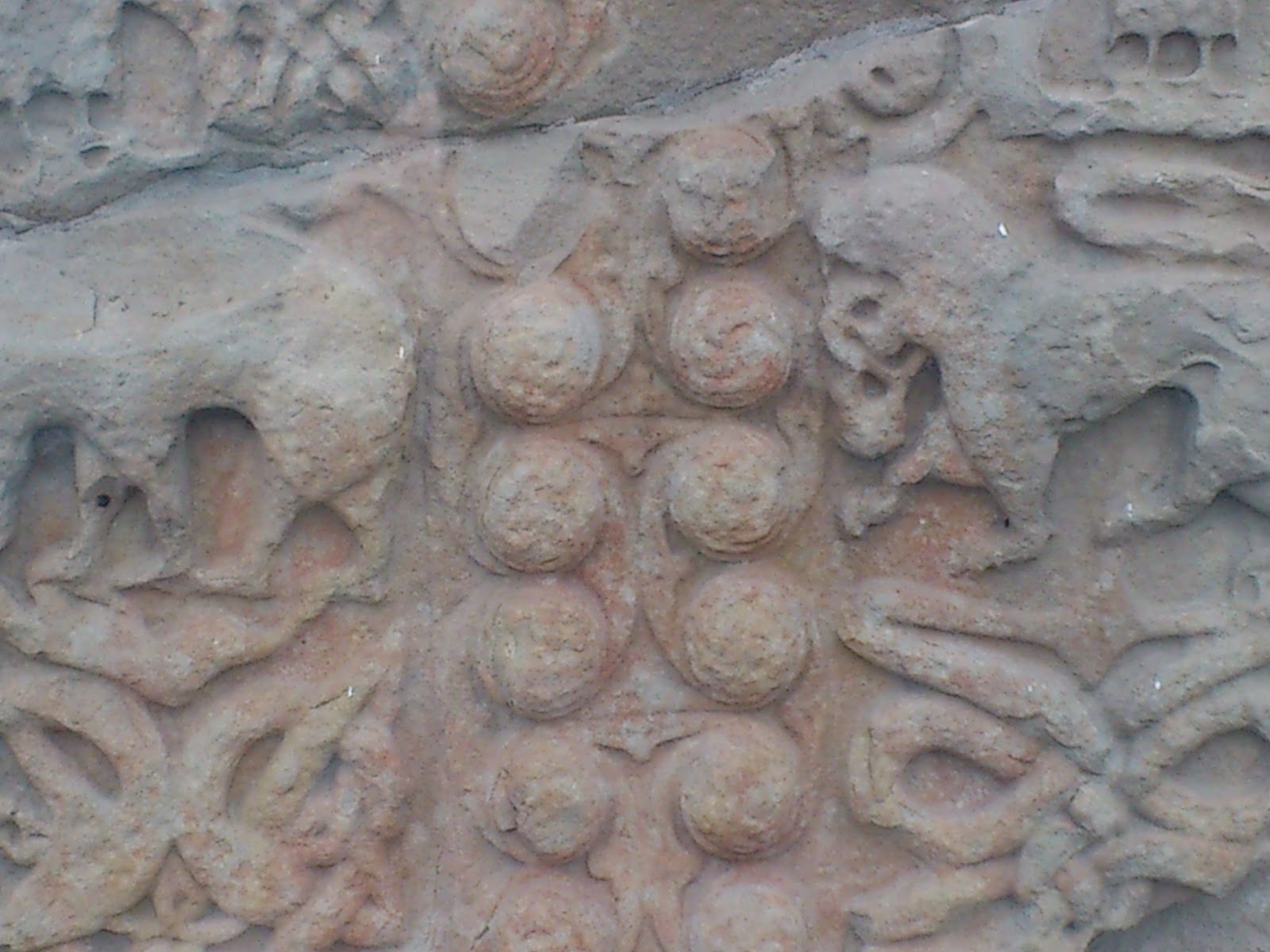
 I came across this quote by Austrian philosopher, Martin
Bruber, back in June: ‘All journeys have secret destinations of which the
traveller is unaware.’ It rang true with me. How impossible it is to say what
you will experience, what will reveal itself on the way. The Churches didn’t disappoint – in particular Fortrose Cathedral and the beautiful church
at Nigg surrounded by its leaf-shaded, mossy graves. But it was the Pictish
relics which really grabbed me on this trip, and remain somewhat mysterious. At
Nigg, Shandwick and Hilton of Cadboll, gorgeously carved monuments have stood
since the early centuries of the First Millennium, which as Stuart McHardy says
in A New History of the Picts represent
‘one of the most under-appreciated collections of art in human history’. I hope
the photos here speak for themselves. But I am hot-footing it to the National
Museum of Scotland to see the Cadboll one which is on display there. They seem
to me a wonderful fusion of pagan and Christian symbolism, and the lack of
written records from this period maintain their enigma.
I came across this quote by Austrian philosopher, Martin
Bruber, back in June: ‘All journeys have secret destinations of which the
traveller is unaware.’ It rang true with me. How impossible it is to say what
you will experience, what will reveal itself on the way. The Churches didn’t disappoint – in particular Fortrose Cathedral and the beautiful church
at Nigg surrounded by its leaf-shaded, mossy graves. But it was the Pictish
relics which really grabbed me on this trip, and remain somewhat mysterious. At
Nigg, Shandwick and Hilton of Cadboll, gorgeously carved monuments have stood
since the early centuries of the First Millennium, which as Stuart McHardy says
in A New History of the Picts represent
‘one of the most under-appreciated collections of art in human history’. I hope
the photos here speak for themselves. But I am hot-footing it to the National
Museum of Scotland to see the Cadboll one which is on display there. They seem
to me a wonderful fusion of pagan and Christian symbolism, and the lack of
written records from this period maintain their enigma..JPG)


