Friday, October 9, 2009

Map as narrative as journey as map

I suppose it’s inevitable that a walker will develop an obsession with maps. I spend hours looking at maps of places I know, or places I plan to go. The imaginative gap between what I read from the configurations of line, shade, and word, and what I meet and feel once in the actual landscape, is always intriguing. Google Earth has never worked the same magic on me, although it can be a useful way of anticipating what to expect, and I was fascinated by Kamila Shamsie’s account of using it to research places for her novel ‘Burnt Shadows’.

I discovered the Roy military maps of the mid 18th century some time ago - gorgeously figurative depictions of Scotland incorporating volcanic bursts of bold shade for hills with the fine detail of settlements. They can be viewed online at the National Library of Scotland, who can also provide copies from the incredibly helpful, and good value map library.

But I’ve only quite recently discovered Timothy Pont’s sketch maps of Scotland made in the late 16th century. He seems to be something of an unsung hero, a young scholar from St Andrew’s University who walked vast tracts of Scotland in what must have been quite hostile conditions to sketch topographies and human settlements as far apart as Dumfries and Durness, including many lands between. He was the earliest known Scottish map-maker, and his sketches were the basis for the first printed maps that appeared in Joan Blaeu’s world atlas of 1654. But his originals remained unprinted until Jeffrey C Stone’s collection appeared in 1989.

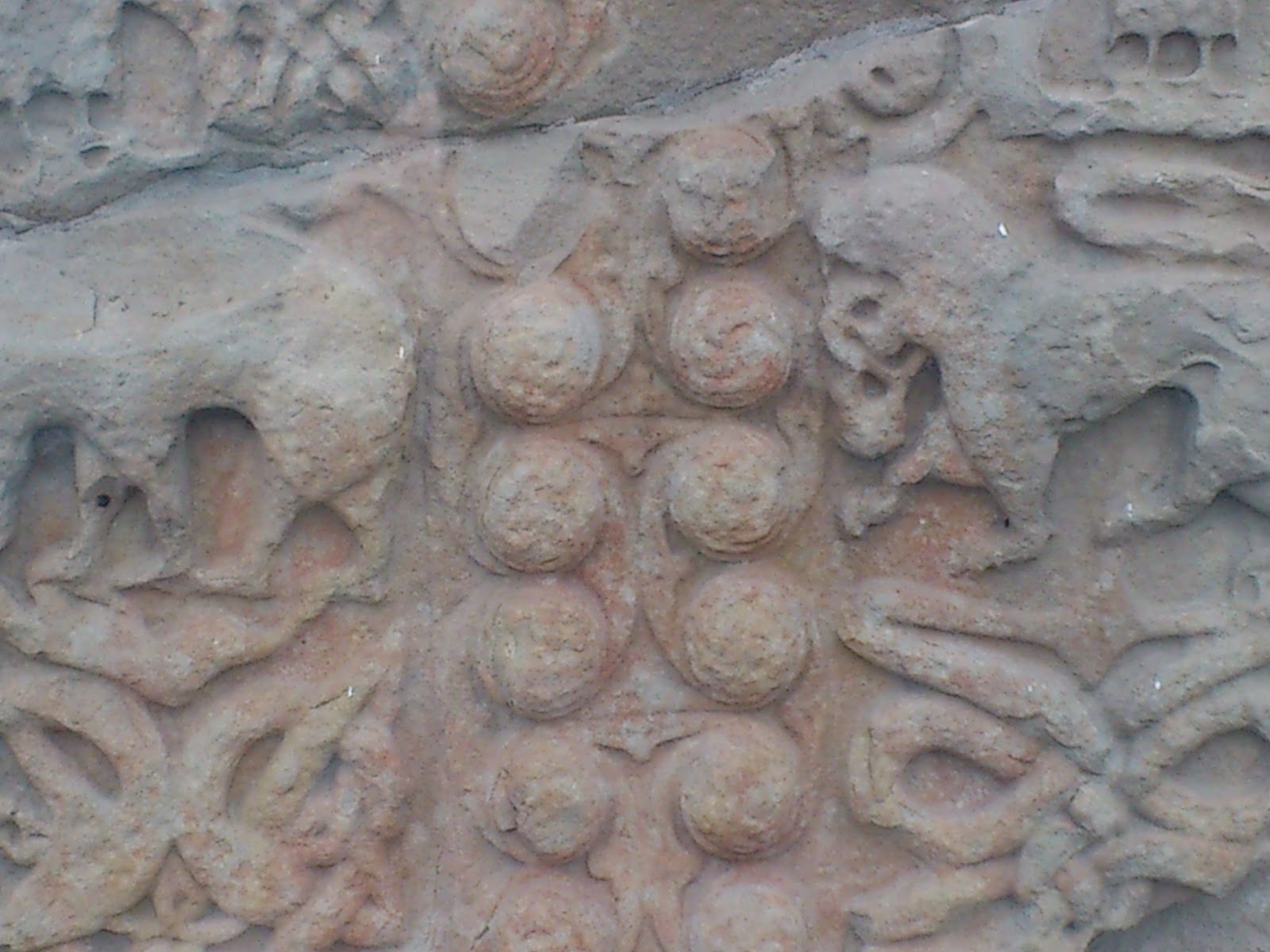
To walk a river valley today, or climb onto a hilltop on the dividing ridge of a watershed, and sketch what we can see without the aid of mapping or surveying tools, would put us on an equal footing with him. (I must try this as an experiment.) His combination of aerial representation and elevation often mean that buildings and hill shapes are recognisable when seen from a particular angle. Some slightly odd representations have fuelled speculation that he sometimes used verbal sources and descriptions to fill gaps in his own observations. He shows us chapels, mines, bridges, islands, antiquities, and placenames, and annotates with field notes. For the far north west corner of the country he wrote: ‘extream wilderness’, and ‘verie great plenty of wolfes doo haunt in this desert places’. He also commented on the lack of trees in Caithness, where he later became Minister of Dunnet Church (pictured below) between 1600 and 1610, where he is now celebrated by a plaque. I am fascinated by what motivated Pont. Is this a general human urge? Are we all driven to map our environment to some extent? I think back to Hamish’s wonderful map, the eight year old son of a friend who continues to pore over maps and make his own with extraordinary skill. And I think of the rock art pictured below that forms part of an amphitheatre of engravings just to the north of the river and west of Weem Castle on Pont’s sketch of the Tay valley above. Could these mysterious engravings have been maps showing the relationship of key places to each other as people conceptualised them in their own minds and tried to show others? The diversity of this act of conceptualisation is demonstrated on a brilliant blog, ‘Strange Maps’.

And now I’ve begun to wander into the relationship between texts, stories and maps. In trying to help students structure essays as part of my Royal Literary Fund (RLF) fellowship at Stirling University, I was struck by this advice which appears on the RLF website: ‘Another way of thinking about the introduction is that it should draw a map for the reader. Imagine you are taking the reader on a journey. Your introduction tells the reader not only the intended final destination but the route you are going to take, the method of transport, the places you are going to visit on the way, the people you are going to meet and even some of the things they are going to say.’ Leslie Stephen described a walk as ‘a little drama itself, with a definite plot with episodes and catastrophes’. In ‘Wanderlust’, Rebecca Solnit says: ‘the long distance walk is an easy way to find narrative continuity. If a path is like a story …then a continuous walk must make a coherent story, and a very long walk makes a full-length book.’

There’s something here I want to pursue. Map as narrative as journey as map. And those ‘haunting wolfes’ must surely be part of the story…

Thursday, September 24, 2009

Equinox on the north coast


Thursday, September 17, 2009

Annandale Way opened with feet and words

Last Saturday, mist cleared to another blue-ceilinged September day and brought over a hundred walkers and runners onto sections of the Annandale Way to meet for celebrations at Lochmaben. Lady Hope-Johnstone spoke and unveiled a finger-post to officially open the 55 mile route, and two of the pupils who had walked and written with me read from the creative writing work which is incorporated into the guide and the wayside interpretation. (More about the development of the project here) Get your copy of the very attractive guide from Sulwath Connections.

Sunday, September 13, 2009

A Wilder Vein back from the printers

What a delight it has been to receive the anthology that I've edited hot of the press from Two Ravens Press. Although publication date is 2nd November, it's for sale before then from their website ONLY at the great price of £8.99, for delivery from 1st October. This not only gives the reader a good deal, but is good news for this small press who are severely challenged by the commercial discounts required by many booksellers.

This is a quality book - looks good, feels gorgeous and packed with diverse and beautifully written responses to the wild places of Britain and Ireland. It includes the extended version of Palestinian writer Raja Shehadeh's piece, pre-published in The Guardian in July. It's very gratifying to see so much work by so many going out to make its way in the book world. Please help it on its way!
Launch events at The Aberfeldy Watermill, Tuesday 27th October with Andrew Greig, Mandy Haggith, Alison Grant and Kenny Taylor; and as part of the Edinburgh Radical Book Fair on Thursday 29th October with readings by Judith Thurley, Ken Wilkie, Andrew Greig and Jane Alexander.

Wednesday, September 9, 2009

Walking The Wall

Last week I walked a 40 mile section of Hadrian's Wall path, starting in the east, on the outskirts of Newcastle, and climbing up to the escarpment of the whin sill where the Wall clings to its tippy edges through the Northumberland National Park. We finally left a rain-sluiced wall at Birdoswald Fort not far from Brampton in Cumbria.

I had glimpsed a tiny section of the wall only once before, and knew little of the World Heritage Site or what to expect. It's not the first time I've written about following a wall on foot, and many of the same fascinations surfaced for me - its fluidity as it snakes across crag-filled landscape; the antique patina of wear and lichen on the stone; the personal legacies of graffiti or other markers left by the builders. However the great age and endurance of the Roman one inevitably raised an even greater sense of marvel at the builders' skills, audacity, and an intrigue with what the Wall has witnessed.
I remember when I was at art college in the 80s and writing a dissertation linked to Land Art that I came across the startling image above - Christo and Jeanne-Claude's 'Running Fence' in California. They described their aim for their art, as to present a different way of looking at landscapes that have become familiar to the general populace, as well as to make the world look more beautiful. It seemed to me as I walked, and as the line of the Wall drew the eye - clinging, curling, cornering, bucking along its scarp like a line of piping on clothing, that at one level Hadrian's Wall provided a stunning visual and aesthetic experience. I hadn't realised that it had originally been plastered and painted white. At fifteen feet in height with regular 'milecastles' and interspaced turrets, journeying at least in its mid sections through high land visible from a great distance on each side, the visual impact must have been enormous. Might people have actually travelled to see it? Of course it was also a massive statement of power, a geopolitical icon with a military function.

As a contemporary walk, the opportunity for absorption in the Roman theme is considerable as the days' march between each major fort gives you the chance to visit Chesters and Housesteads Forts, as well as other less 'museumified' remnants of Roman civilisation. Here I found my imagination rebuilding entire impressive facades from remnants of gates and buildings. I was fascinated by the sophisticated ways of moving water for need and pleasure - for the bath houses, and particularly the technology associated with toilets. Stones moulded to butt up against wooden doors; the circular depression in a flagstone where a door pin would rotate; the contrariness of blundering yet exact placement of stones for function, and its regularity against nature. This engineering reminded me greatly of my explorations of the Mozarabic trails in south-eastern Spain, and made me think I had perhaps under-appreciated the legacy of the Roman precedent to the Arab engineering wonders there.

As you walk, there is a steady drip drip of information which starts one dreaming, questioning, speculating about the life along the Wall from then until now. Walking from the east provided an easy, flattish, start for the first day, but the Wall was a phantom. The lumps and bumps of the defensive earthworks either side had to suffice. The 'Military Road' (B6318) sizzling with Bank Holiday traffic on the first day felt too close a companion. A lazy path follows a road I thought. But had to adjust my thinking. General Wade's 18th century road was built on the Wall and is still in use. Its retaining wall often bears the hallmark of regular cut whinstone, clearly one and the same with Hadrian's masterpiece (see above). The path therefore had to follow the road, at least until the rise up to Sewingsheilds Crag. From there, road and Wall separate, and there is a considerable stretch of well-preserved masonry right up until Walltown quarry, perhaps for the very reason that access for locals to remove and 'recycle' stone for houses, churches etc was less easy.


Some other links of interest to the Wall: A community creative writing project called 'Writing on the Wall' ran between 2001-6 and was inspired by the 2000 year old Vindolanda Tablets, discovered at a Roman fort just south of the Wall. (They're the earliest written texts in Britain, now held in the British Museum. Fascinating reflections of everyday life including a request for more beer, and for underpants!) I've also just discovered that Mark Radcliffe and Stuart Maconie are currently walking it for a series of their shows on BBC Radio 2. Thursday's will include poet Simon Armitage so worth a listen I would think. And finally Durham University have been involved in an interesting research project, 'Tales of the Frontier', exploring the significance of the Wall and its landscape as both monument and icon from the time of Bede (C8) until today.

Tuesday, September 8, 2009

Jessie Kesson's nature writings

One thousand feet up on the hillside at Abriachan where the winds sing over the brow of the steep western slopes of Loch Ness, a dormer-windowed house straddles lush pasture land and the scratch of heather on the open moor above. This is Achbuie, where at the age of nineteen, prolific writer Jessie Kesson (1916-1994) went to rehabilitate after a ‘lost year’ of virtual imprisonment in a mental hospital. She was ‘boarded out’, as the practice was known, living with and helping an elderly woman on her croft. The experience of Spring here flushed her into an ecstatic appreciation of nature, and spelt out for her recovery, re-growth and a sense of freedom. Amongst the smell of bracken-mould and primroses, on a hill so high up that ‘you feel any moment you might topple into Loch Ness below’, she walked ‘without limits of walls’.

When I set off to explore Kesson’s terrain in 2008 for my own essay for Doubling Back, I wanted to draw more than a glimpse of her hillside. I wanted to share her exuberance and find the Red Rock she wrote about. I ‘found’ Jessie’s hillside, in the sense that my own rambles seemed to correspond with the joyful arrangements of her own words evoking Spring here, and because I took the sunny green slopes below Achbuie rather than the bleak moor bristling above.

I sought out her other writing, read more of the fictionalised re-workings of her own traumatic childhood years. The dull bass beat of pain was always there, but somehow overlain with bright, poetic joys found in nature or brief moments of love and belonging.

I've written before here about Jessie Kesson's life and writing of this time and place, which bubbled up in much of her later work, including the twelve essays she wrote as 'Ness MacDonald' for the Scots magazine during 1946, entitled 'The Country Dweller's Year'. Last year I had to go to the National Library of Scotland in order to read them, but I'm delighted that these essays and various other pieces of her writing - essays, drama for radio, poetry, fiction - in response to nature during her early writing career, have recently been collected by her biographer Isobel Murray and issued by Kennedy and Boyd. As Murray says they demsonstrate 'a passionate response to the natural world' in a style of writing that is lyrical even in prose, and yet earthy and direct as if the language itself is inflected by place, smell, and song.

Walking the World

This collaboration between Orion magazine and Words Without Borders looks interesting - writings in translation about varied walks.