Showing posts with label pilgrimage. Show all posts

Tuesday, October 16, 2012

Walking with animals


My article below has recently appeared in The Geographer, the newsletter of the very wonderful Royal Scottish Geographical Society who helped organise this July 2012 journey in partnership with Speygrian. Any observations on walking with animals very welcome.
 
 
A Love Affair and a Dirty Right Arm       

 ‘If this is Montana,’ Vyv said, ‘What I want to know is, where’s Robert Redford?’
We were in the southern reaches of the Cairngorms, at Kirkmichael, and our two and four-legged cavalcade had just carved its way through the hills from Newtonmore via Blair Atholl, taking five days to cover 60 miles. The journey itself over rivers, through forests and valleys sculpted by ice, had seemed so much longer, made us feel so much smaller than the miles implied. Obviously, we were in Montana.
Our group – a sort of mobile conference of teachers, artists, writers, ecologists, pony enthusiasts, geographers – grew and shrank, transforming across the week. At our communal heart was a fascination with journey, as well as individual motivations such as a wish to walk with animals, explore and draw inspiration from the landscape, follow old ways and keep traditions alive.
Through glens and over passes we followed routes which had once forged lively connections between places. On the second day, we climbed high out of Glen Feshie, into smirr, onto Meall an Uilt Chreagaich. From there, a steep and slippery traverse south west over Leathad an Tobhair, would join us to the Minigaig Pass, the summit of a once important north-south road, and a possible route for drovers from Speyside to the cattle sales in Crieff or Falkirk. After Wade built the military road over Drumochter in 1729, it was used by many more drovers to avoid paying tolls.
The difficult, trackless section had challenged us, unsettled our steady progress. Laughter had hushed. Then, processing across a high plateau with banks of cloud rolling at our side, and perhaps in one of the remotest places in Britain, a large lump of white quartz gleamed against the dark heather, out of mist.
‘Here we are,’ said Ruaridh.
A further glint of white ahead, and another, more mistily beyond that, confirmed we were re-treading an ancient way as hooves and boots struck into soft peat on our gradual descent into Glen Bruar. As the first party to take animals this way for 100 years, we drew confidence from our forebears.
We only had cattle with us on the first day, but our Highland ponies, provided by Newtonmore Riding Centre, came all the way. They were sturdy and yet spirited, descended from mares owned in the early nineteenth century by a famous Lochaber drover. I’m sure those of us who had not travelled with pack animals before anticipated an easier hike without the burden of a heavy rucksack.
However, handling the ponies needed constant communication and concentration, not least in an effort to keep our feet from under theirs. With one hand on the rein we sought a trusting connection. Too long and she might trip on it or sense a lack of guidance; too short and her freedom to jump obstacles on rough ground or find the surest way was compromised. All other tasks – sandwich eating, rearrangements of pannier or rucksack – had to be carried out with one hand. The clothing of our leading arms was gradually rubbed dark against sweaty necks, grassy mouths.
Our steps soon rhymed with theirs. With their heads nodding, breathing softly next to us, they clip-clopped their way into our hearts. Their names rang in our mouths like a poem: Torr, Zino, Bean, Blue, Breagh, Alice, Ailsa, Micky, Mack, and Marigold. The rhythms of any camping journey – pitching tents; cooking; sleeping; were extended by looking after the ponies’ needs – untacking; turning them out; finding water. At night they grazed close to our tents, their snorts oddly comforting; hooves drumming through our dreams. In the mornings they gathered at the fence, watching us, apparently curious.
Despite our often remote location, and the sense at times of a haunted, abandoned landscape, each night we had extra company of some sort; folk joining us with songs or stories, or hosting us in their fields and steadings. At Bruar Lodge, three girls welcomed our tetchy arrival with smiles, and carrots for the ponies. At Newtonmore and Blair Atholl, ‘Meet the Drovers’ events gathered local people and tourists to pat the ponies and ask about the journey. We drew local families after us in a carnivalesque wake for the sunny miles down Glen Fearnate and into Kirkmichael before our final event there. It was clear a nerve had been tingled by our quirky procession; a way of life suggested; a landscape looked at in a new light.
For this drover at least, my walk across Montana was enriched by rekindling a teenage love affair. I never did see anyone resembling Robert Redford. But, ah, the ponies and their dear sweet ears...


Friday, June 1, 2012

The King's Way

 A delightful four-day walk over last weekend, joining up places I know with new ones, and making them into a continuous journey: Inverness to Tain. Lines carved through ripe barley fields; sunshine, skies of searing blue followed by cool, clamping haar; Hugh Miller’s fossil rich sandstone coast up the Black isle to Cromarty; cavorting dolphins gathering a hushed congregation on the beach, resembling churchless worshippers.


 Walking with a friend who will soon start training as a Unitarian Minister, we chose the route because we liked the idea of Pilgrimage. Known as ‘The King’s Way’, this was a pilgrimage trodden many times by James IV to reach St Duthac’s shrine in Tain, but was only the northern section of a much older pilgrimage route which linked St Ninian’s shrine near Whithorn in Galloway, spanning a huge swathe of Scotland.

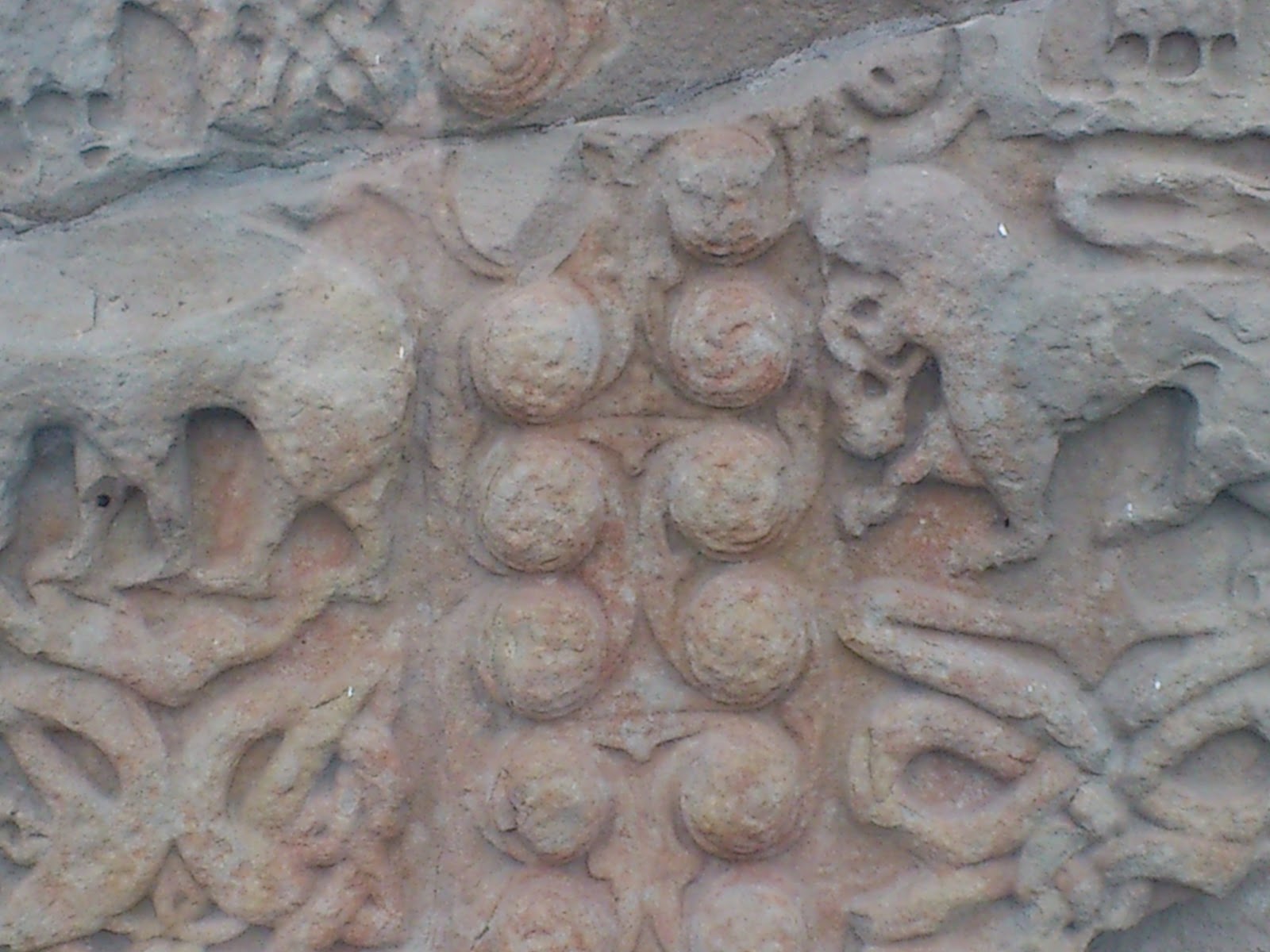
I came across this quote by Austrian philosopher, Martin Bruber, back in June: ‘All journeys have secret destinations of which the traveller is unaware.’ It rang true with me. How impossible it is to say what you will experience, what will reveal itself on the way. The Churches didn’t disappoint – in particular Fortrose Cathedral and the beautiful church at Nigg surrounded by its leaf-shaded, mossy graves. But it was the Pictish relics which really grabbed me on this trip, and remain somewhat mysterious. At Nigg, Shandwick and Hilton of Cadboll, gorgeously carved monuments have stood since the early centuries of the First Millennium, which as Stuart McHardy says in A New History of the Picts represent ‘one of the most under-appreciated collections of art in human history’. I hope the photos here speak for themselves. But I am hot-footing it to the National Museum of Scotland to see the Cadboll one which is on display there. They seem to me a wonderful fusion of pagan and Christian symbolism, and the lack of written records from this period maintain their enigma.


I love the opportunity to learn on a walk, and the surprises. So perhaps it was a pilgrimage of sorts, after all, even though we missed Saint Duthac's shrine (it closes at 5pm) and had to make do with a dazzling arrival at Tesco's for cold pepsi instead!

Monday, October 27, 2008

Last blast of light


‘You’ll be the last this year’, the landlords of pubs and B+B’s kept saying to us ‘pilgrims’ along Saint Cuthbert’s Way. Certainly we saw no-one else who seemed to be doing the full 62 miles from Melrose in the Scottish Borders to Holy Island in Northumberland, or the reverse. And yet it seems to me the perfect season in which to walk it, when the tree colour is mesmerising, particularly in the early stages of the walk where it’s reflected in the Tweed River, then flaming up from the monumental beeches and oaks of Dere Street and zig-zagging bright cloisters of leaf through the plains of farmland that lead towards the Cheviots.

Just before the clocks change in late October, daylight is just generous enough, and it feels to me exactly when we need some long days outside, to refresh the body with physical movement, to feel the spark of sun and rush of the wind on our skin, before we give in to the dark. On the way, I came across a poem called ‘The Invitation’ by Charles Kingsley, in which he invites a friend to walk with him in places close to home, ‘Washing brain and heart clean/Every step we take.’ I also loved his lines about what one can discover on a walk: ‘See in every hedgerow/Marks of angels' feet,/Epics in each pebble/Underneath our feet.’


This territory was relatively unfamiliar to me, and I loved the sense of discovery, of not knowing what to expect as the waymarks led us forward, out of the woods and onto the muscular Cheviot hills – St Cuthbert’s beloved ‘high, rugged places’ – towards the coast. The pebbles under our feet certainly cast up stories. The elfland under the Eildon Hills where the Fairy Queen carried off Thomas the Rhymer for seven years, feeding him a red apple which meant he was only able to speak truth. ‘Lilliard’s Stone’, commemorating a wonderful fiction about a woman who fought on her leg stumps following terrible injury in the Battle of Ancrum in 1545. A legend of leg ends, so to speak. Bede’s stories of St Cuthbert’s affinity with wild creatures and birds in particular, took flight with merlins, owls, and waders as we approached the mudflats around Lindisfarne.


Our crossing of the ‘Pilgrim’s Way’ over the sands at dusk with an incoming tide took on it’s own ‘epic’ quality. We were blessed with a couple of days of sparkling clear skies, and with that particular east coast clarity, the dusk light washed over the wet sands. It looked as though we were walking on water as we followed the marker posts across, our destination a narrow strip of land between lilac sky and lilac sheen as seals sang us in from St Cuthbert’s Isle, and the barnacle geese squabbled loudly behind us, neither groups visible. Diverting at one point to avoid the licking tongue of tide, we rejoined the marked route, not fully realising how night had taken charge until we arrived amongst the lit-up windows of stone cottages, winding through the narrow streets of Lindisfarne village towards our final stop at The Crown and Anchor.


The year's final blast of wind and sunlight, violet skies, moss-coloured seas, out in the world with the stalk and strut of wading birds. Then home, to the change in clocks, the darkness, the hermit’s life.